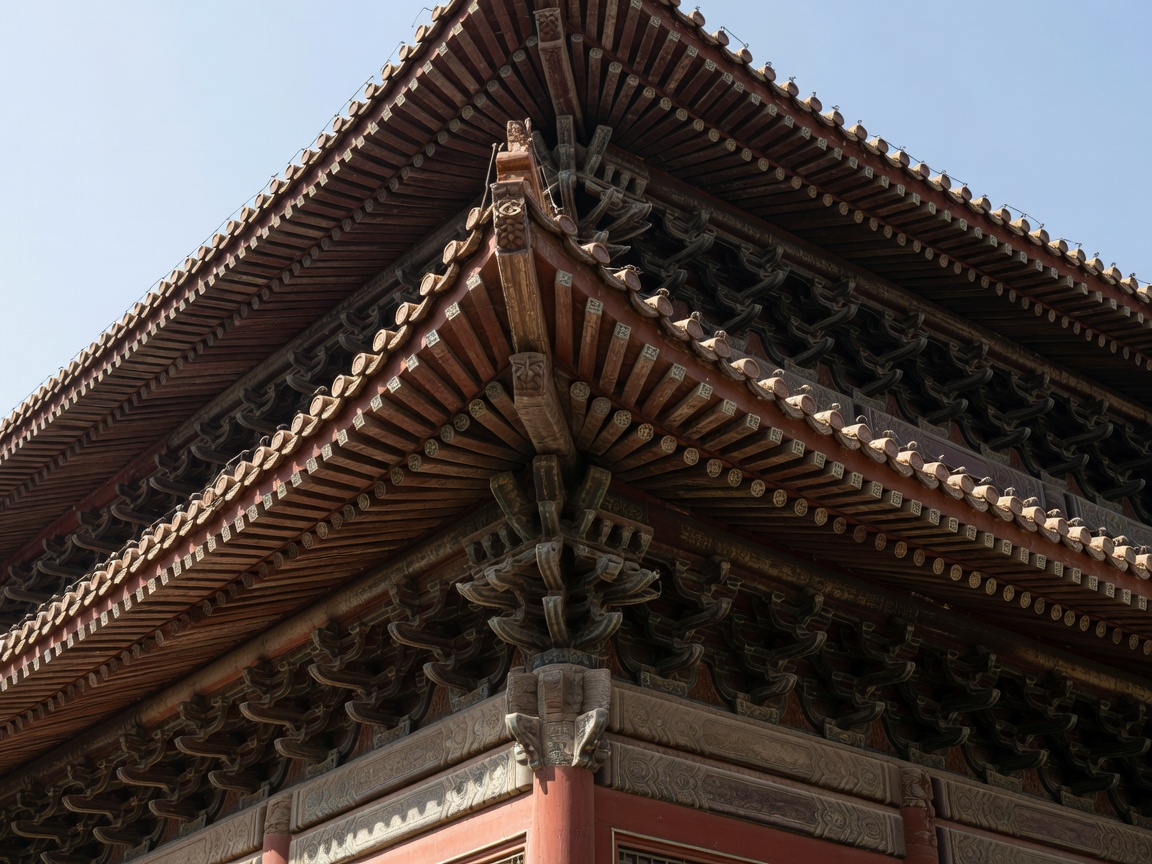
Walk under the eaves of any major hall in the Forbidden City and look up. You will see the same cluster of timber blocks and arms repeated across the façade, bay after bay. It is tempting to see a code in such regularity. The first and better question is structural: what is this repetition holding up?
Repetition as structure
Chinese timber architecture is organised by the jian, the bay between two columns. A hall is described by how many bays wide it is, and each bay receives its own bracket sets, or dougong. These stacked blocks and arms spread the load of heavy tiled roofs onto the columns and let eaves project far beyond the walls. Their repetition is therefore a direct expression of the column grid.
That does not make them meaningless. The number and complexity of bracket tiers signalled rank, and Qing regulations restricted elaborate bracketing to buildings of high status. But the meaning grows out of the structure; it is not hidden inside it. The Hall of Supreme Harmony is wide and heavily bracketed because it was the most important ceremonial hall, and its builders had rules about how importance should look.
Repetition as procession
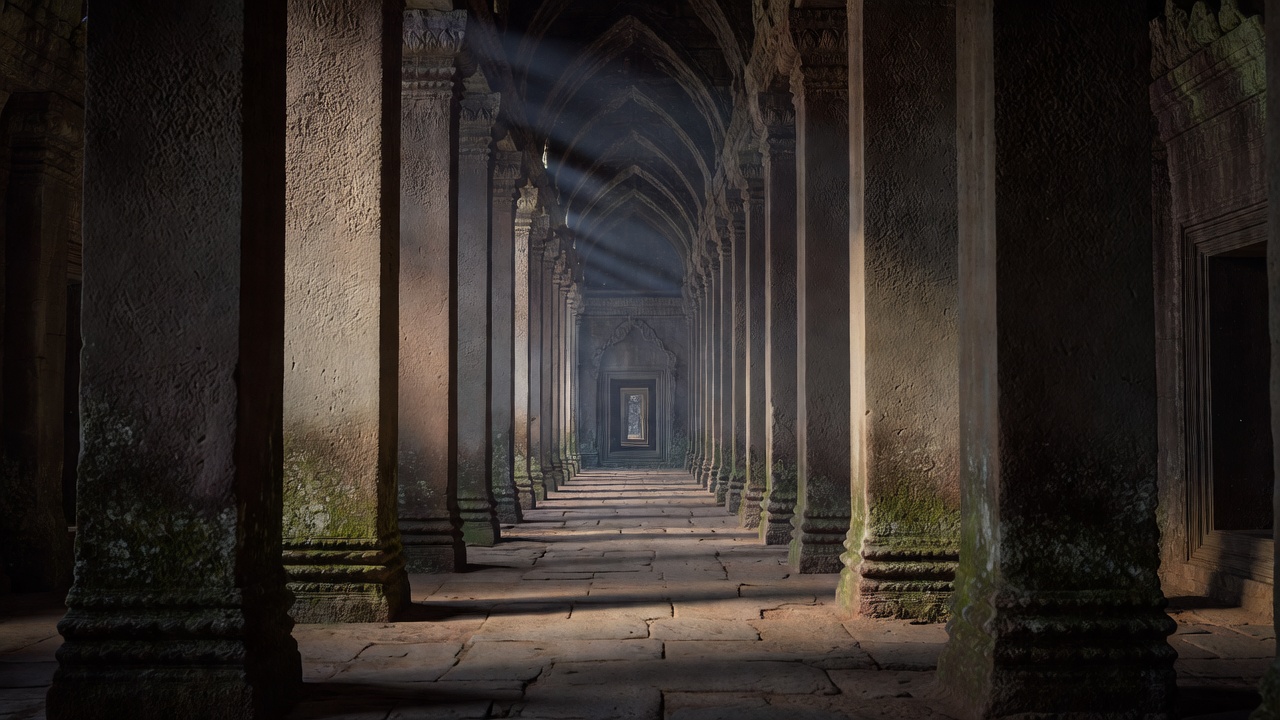
At Angkor Wat in Cambodia, galleries of square pillars run around each enclosure. Walking them, you pass the same column profile hundreds of times, while the reliefs on the inner walls unfold continuous stories, including the Churning of the Ocean of Milk on the east gallery. Here repetition sets a pace. It turns movement into a measured approach towards the central towers.
The same logic appears in the Thousand Torii at Fushimi Inari Taisha in Kyoto, where gates donated by individuals and businesses line the mountain paths. The rhythm is real, but its origin is documented donation, not a designed numerical scheme.
Repetition as accumulation
The plain at Bagan, in Myanmar, holds more than two thousand surviving temples and stupas, most built between the 11th and 13th centuries. From above they look like a deliberate pattern. In fact they record centuries of individual acts of merit by kings, officials and families. The visual repetition is a social record. Reading it as a single master plan would erase the people who paid for each building.
Borobudur in Central Java is different. Its 72 perforated stupas on the circular terraces were clearly planned as a set, arranged in rings of 32, 24 and 16. Accumulation and design are two distinct sources of repetition, and the difference matters.
Darb-e Imam, Isfahan
The shrine's tilework uses girih patterns. In 2007, Peter Lu and Paul Steinhardt showed in Science that parts of it can be described with a near-quasicrystalline tiling.
Intentional mathematics?
Whether 15th-century craftsmen understood the pattern in anything like modern mathematical terms is unknown. Their methods survive only partly, for instance in the Topkapı Scroll.
Repetition as craft
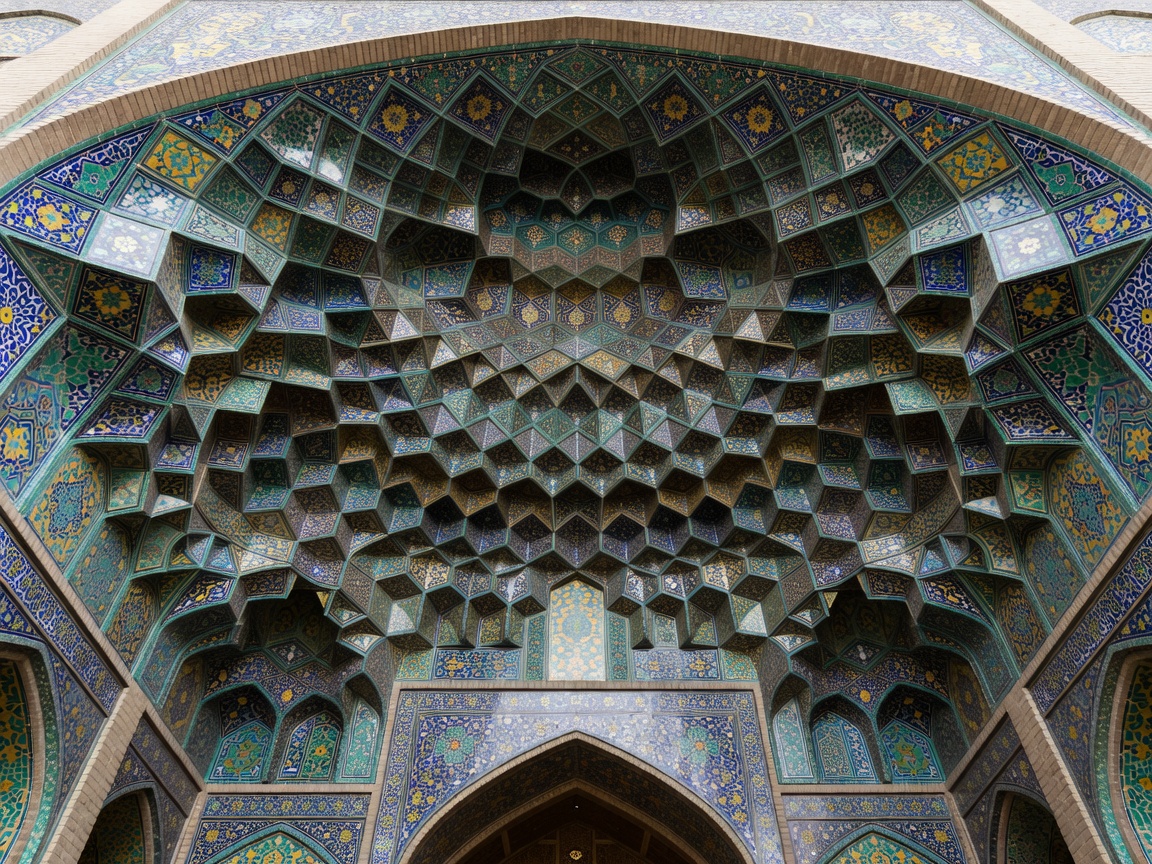
Muqarnas vaults, such as those in the Shah Mosque and the Sheikh Lotfollah Mosque in Isfahan, are built from small repeated cells that step outwards to bridge a square room to a dome. The geometry is sophisticated, but each cell is also a unit a workshop can cut, test and assemble. Repetition is how complex surfaces become buildable.
"The column grid is the grammar; ornament is the accent."Our working rule for reading timber halls
A reading checklist
When you meet repetition on a site, try these questions in order. Does it carry load or enclose space? Does it set the pace of movement? Was it accumulated over time by different patrons? Was it a workshop method? Only after these should you ask what it symbolised, and then look for a text, inscription or living practice that supports the answer.
Continue with how symbols depend on their setting, or see how repetition becomes proportion in temple geometry.
Source notes
- Li Jie, Yingzao Fashi (1103) and the Qing Gongbu Gongcheng Zuofa (1734) on bracket rank.
- Lu, P. J. & Steinhardt, P. J., "Decagonal and Quasi-crystalline Tilings in Medieval Islamic Architecture", Science 315 (2007).
- UNESCO World Heritage files: Angkor (1992), Bagan (2019), Borobudur Temple Compounds (1991).