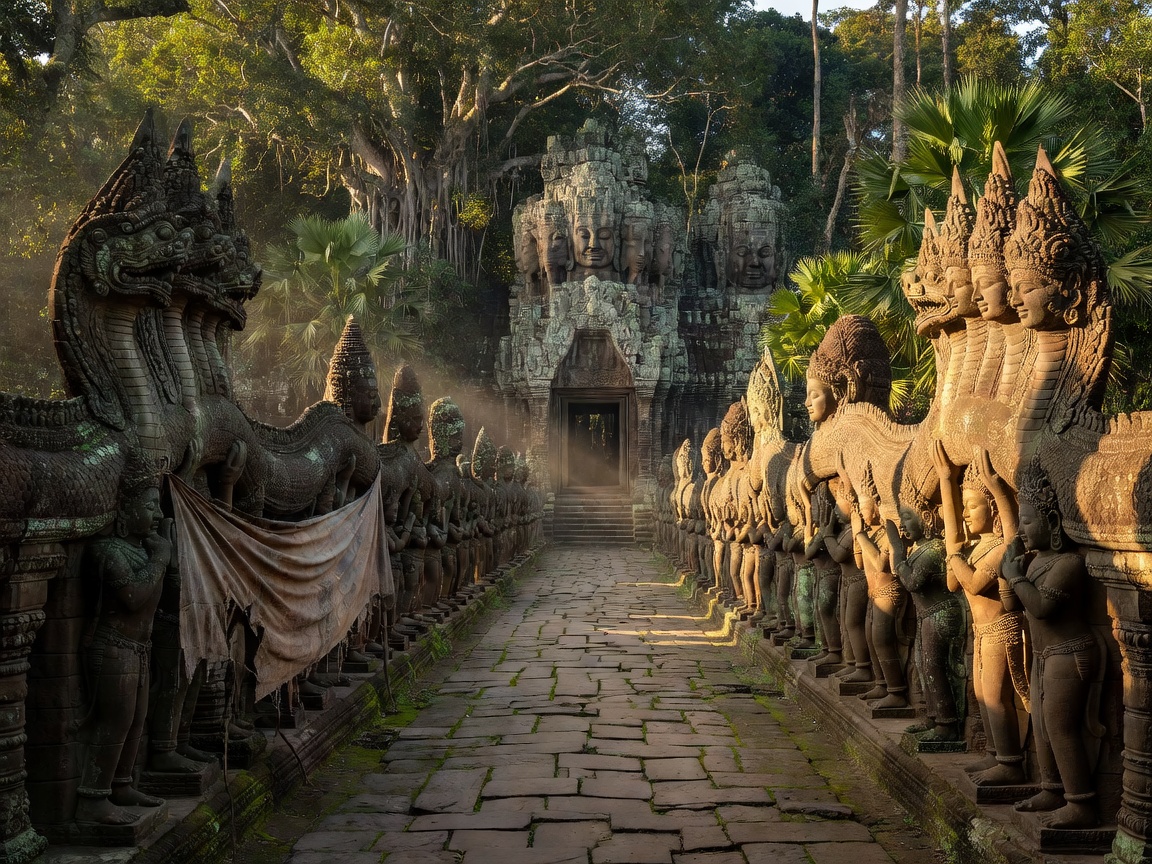
Stand at the south gate of Angkor Thom and look along the causeway. On each side, a line of stone figures grips the long body of a many-headed serpent. Out of context, it could be decoration. In context, the reading is unusually well supported.
The causeway nagas of Angkor Thom
The figures on one side are generally identified as devas, gods, and on the other as asuras, their rivals. Together they appear to haul the naga Vasuki, echoing the Churning of the Ocean of Milk, a myth carved in full on Angkor Wat's eastern gallery a generation earlier. The scene sits at a city gate built by Jayavarman VII, whose inscriptions present his capital as an ordered cosmos. Myth, location and royal programme align. That convergence is what makes the interpretation strong.
Elsewhere in Khmer and Thai architecture, naga balustrades line approaches to temples without any churning figures. There the serpent works more as a guardian and a bridge between the human and divine realms. Same creature, different job.
Roof creatures in Beijing
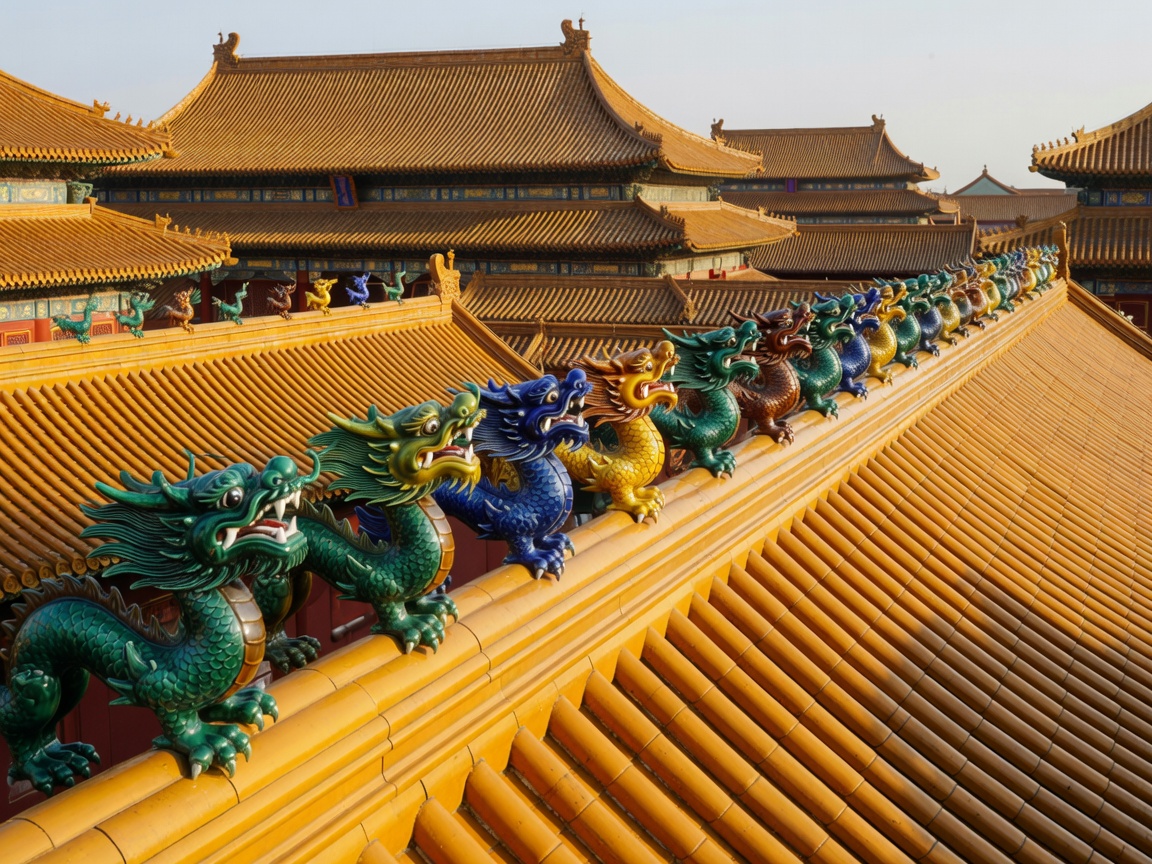
Along the hip ridges of imperial Chinese roofs stand small glazed figures: a man riding a bird at the front, then a sequence of creatures such as a dragon, phoenix, lion and sea horse. Their number is a documented rank marker. The Hall of Supreme Harmony carries ten, a count unique to it; lesser halls carry nine, seven, five or fewer. The figures are often described as protective, and the riding figure has many folk explanations, but the number itself is the clearest evidence of meaning: hierarchy, written in ceramic.
The svastika in South and East Asia
Visitors are sometimes startled by the svastika on temples in India, Nepal, Japan or Korea. In Hindu, Buddhist and Jain contexts it is an ancient auspicious sign; the Sanskrit word relates to well-being. On Japanese maps, the related manji has long marked Buddhist temples. Its 20th-century appropriation in Europe is a separate history. Reading the symbol correctly here depends entirely on its setting, and on respect for the communities who continue to use it.
Konark's wheels
The 13th-century Sun Temple at Konark, Odisha, attributed to King Narasimhadeva I of the Eastern Ganga dynasty, was designed as the chariot of the sun god Surya, with carved wheels and horses. The chariot is documented by the form itself and by the deity.
Chariot of Surya
- 24 elaborately carved wheels around the base.
- Horses at the front, now partly lost.
- Dedicated to the sun deity.
Working sundials
- Guides often demonstrate telling time from the spokes' shadows.
- The idea is popular, but we have found no medieval text confirming the design intent.
Colour as symbol: Korean dancheong
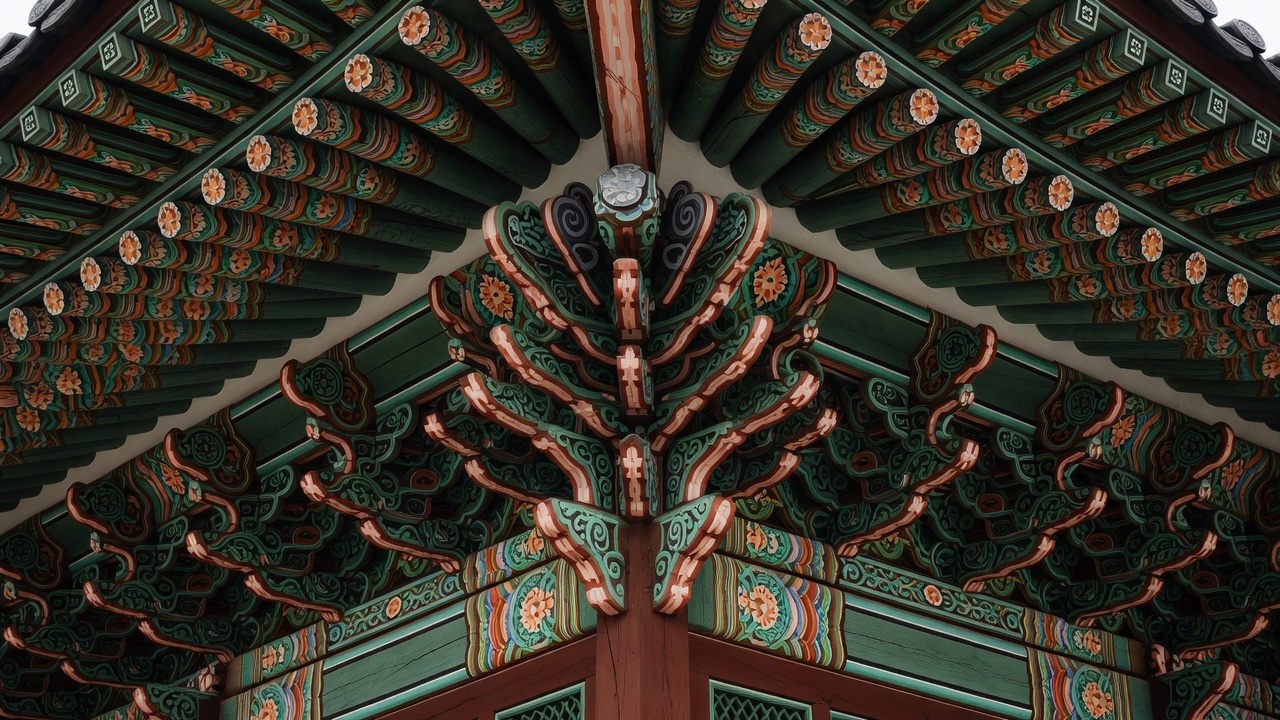
The painted timberwork of Korean palaces and temples, called dancheong, uses a palette linked to the traditional five colours associated with directions and elements. It also protects wood from weather and insects. Practical and symbolic functions coexist, and neither cancels the other.
"A symbol carved at a gate and the same symbol carved in a sanctum are two different sentences."Part Riddle Garden editorial note
For how symbols sit within larger systems of proportion, continue to temple geometry, or see the written rules behind them in design codes.
Source notes
- UNESCO World Heritage files: Angkor (1992), Sun Temple, Konârak (1984), Imperial Palaces of the Ming and Qing Dynasties (1987).
- Inscriptions of Jayavarman VII as summarised in Claude Jacques and Michael Freeman, Angkor: Cities and Temples.
- Qing building regulations on roof ornament rank.